


The Bulk Production Brown Cross Body Handbag by PrinceBag Factory represents a blend of scalable manufacturing expertise and market-ready design. For retailers, wholesalers, and brands seeking consistent product quality, competitive pricing, and reliable lead times, partnering with an experienced factory is essential. PrinceBag Factory specializes in cross body handbags—particularly the brown leatherette and genuine leather variants—offering a production framework optimized for bulk orders while supporting customization, compliance, and efficient logistics. This article provides a professional, in-depth exploration of the product’s design, materials, manufacturing flow, cost structure, quality control, sustainability considerations, and go-to-market recommendations to help buyers and product managers make informed sourcing decisions.
Product Positioning and Target Market
The brown cross body handbag is positioned as a versatile everyday accessory. Its primary target segments include:
– Mid-market fashion retailers looking for reliable staple items.
– Online direct-to-consumer (DTC) brands seeking private-label options.
– Corporate gift and promotional buyers requiring bulk, brandable accessories.
– Regional distributors and boutiques needing seasonless inventory.
Brown, as a neutral hue, has strong appeal across both genders (depending on styling), multiple age groups, and regions, making it a safe, high-turnover SKU for bulk assortments.
Design and Materials: Balancing Cost and Perceived Value
A successful bulk product must balance material costs with perceived value. For the brown cross body handbag, common material choices include PU leather (faux leather), genuine cowhide, and hybrid options (PU exterior with leather accents). Lining materials are typically polyester or cotton blends, and hardware choices (zippers, buckles, D-rings) range from nickel-plated zinc alloy to brass for higher-end SKUs.
Key design elements to consider:
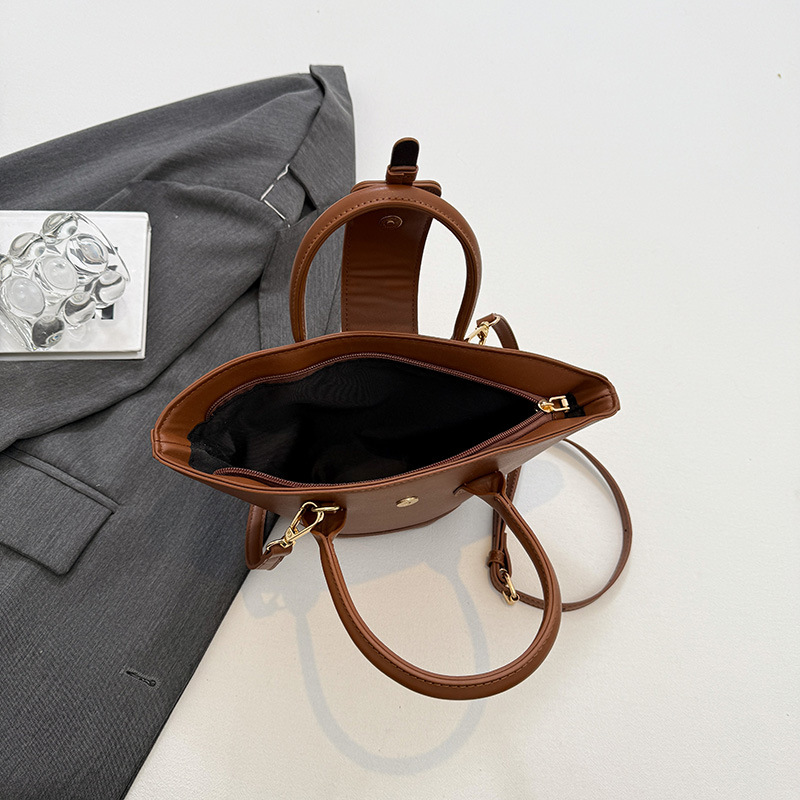
– Bag dimensions and capacity: optimized for phone, wallet, keys, and small accessories.
– Strap design: adjustable cross body strap with swivel hooks or sewn-in strap for cost savings.
– Closure type: magnetic snap vs zipper (zippers add cost but improve security).
– Internal organization: one or two compartments, card slots, or zippered internal pocket.
– Branding: embossed logo, woven labels, or metal plaques—each with different tooling or unit costs.
Selecting materials intentionally allows PrinceBag Factory to offer tiered pricing while maintaining consistent construction standards.
Material Options and Price Tiers
– Value Tier: PU leather exterior, polyester lining, nickel-plated hardware. Ideal for large-volume promotions and low-price retail channels. Lower unit costs and faster MOQ fulfillment.
– Mid Tier: Higher-grade PU or bonded leather, cotton/poly lining, upgraded YKK zippers, custom metal logo. Balanced price-to-quality for mainstream retail.
– Premium Tier: Full-grain or top-grain leather, natural lining (cotton/linen), brass hardware, handcrafted finishing. Higher CAB (cost against buyer) but supports premium retail pricing.
Manufacturing Process: Streamlined for Bulk Efficiency
PrinceBag Factory’s bulk production workflow typically includes: sampling, pre-production order (PPO) confirmation, material procurement, cutting, stitching, assembly, hardware installation, finishing, quality control checkpoints, packing, and logistics.
Key phases:
– Pre-production sample (PPS): Finalize design, materials, and measurements. Approve trim and mock-ups.
– Material procurement: Lock in leather/PU quantities and hardware lead times to secure cost stability.
– Cutting and component prep: Use jigs and die-cutting for PU to improve consistency in high-volume runs.
– Stitch and assemble: Trained operators and industrial machines produce consistent seams and edge finishes.
– In-line quality checks: IPQC (in-process quality control) to catch deviations early.
– Final QC and testing: FQC (final quality control) includes stress tests on straps, seams, and hardware.
For bulk orders (e.g., 500–5,000 units), PrinceBag Factory can allocate a production line with dedicated QC staff and optimized scheduling to ensure predictable delivery.
Typical Lead Times and Minimum Order Quantities (MOQs)
– Sample development: 7–14 days (plus shipping).
– Pre-production and tooling (if needed): 7–21 days.
– Bulk production: 30–60 days depending on order size and material availability.
– Typical MOQ: 300–1000 units per SKU for standard versions; 100–300 units for private-label small runs if using in-stock materials.
Lead times and MOQs are negotiable depending on existing inventory, material availability, and peak factory workload.
Quality Control and Compliance
Bulk production must preserve quality consistency across every unit. PrinceBag Factory employs a multi-tier QC approach:
– Incoming Quality Control (IQC): Inspect incoming leather/PU sheets, linings, and hardware against specs.
– In-Process Quality Control (IPQC): Monitor seam strength, alignment, and tolerances during assembly.
– Final Quality Control (FQC): Random sampling of finished units to verify aesthetics, function (zippers, magnetic snaps), strap durability, and packaging.
– Lab testing: For regulated markets, test for restricted substances (e.g., heavy metals in hardware, PVC phthalates) and flammability where required.
Adopting AQL (Acceptance Quality Limit) sampling plans (commonly AQL 2.5 for major defects, AQL 4.0 for minor defects) helps balance quality and shipping timelines.
Inspection Checklist Highlights
– Material color and texture match to approved sample.
– Stitch density and seam straightness.
– Hardware finish and operation (zippers open/close smoothly).
– Strap attachment strength and stitching reinforcement.
– Interior lining seam quality and pocket function.
– Packaging and labeling accuracy.
Cost Structure and Price Modeling
Understanding cost drivers is essential for pricing and margin planning. Key cost components include raw materials, labor, overhead, tooling, QC, packaging, and freight.
Common cost ranges (indicative, per unit, USD):
– PU leather style: $6–$12 unit production cost.
– Mid-tier PU/custom hardware: $12–$20.
– Genuine leather: $18–$40+ depending on leather grade and labor intensity.
– Packaging (box, dust bag, paper tags): $0.70–$3.00 per unit.
– Tooling or mold fees (one-time): $50–$500 depending on custom hardware or molds.
Suggested retail pricing typically follows a 2.5–3.5x keystone markup from factory FOB price for retail channels; DTC brands can use slimmer margins with higher volumes.
Pricing Scenarios
– Value bulk: FOB $7–$10 → Wholesale $14–$20 → Retail $30–$45.
– Mid-tier private-label: FOB $14–$22 → Wholesale $28–$44 → Retail $60–$100.
– Premium leather: FOB $25–$40 → Wholesale $50–$80 → Retail $120–$200+.
Include contingency for tariffs, inspection fees, and seasonal surcharges when projecting landed costs.
Analysis Table: Production Breakdown and Recommendations
| Component | Specification | Unit Cost (USD) | MOQ Impact | Recommendation |
|---|---|---|---|---|
| Exterior Material | PU leather (1.2mm), brown, grain finish | $2.50 – $6.00 | Lower MOQ possible using in-stock color; custom colors raise MOQ | Use standard brown shades from factory palette for lower costs; upgrade to premium PU for mid-tier lines |
| Hardware | Zippers, swivel hooks, D-rings, metal logo | $0.50 – $3.00 | Custom plating or logo hardware increases MOQ and lead time | Opt for stocked hardware for bulk; reserve custom metal logos for premium SKUs |
| Lining & Pockets | Polyester lining with inner zip pocket | $0.80 – $2.00 | Low impact on MOQ | Standardize pocket layout to reduce assembly complexity and costs |
| Labor & Assembly | Cut, stitch, assemble per unit | $1.50 – $6.00 | Lower per-unit labor cost with larger runs | Batch production and line balancing to minimize rework and idle time |
| Packing & Labeling | Box, swing tag, care card, polybag | $0.70 – $2.50 | Minimal impact on MOQ | Negotiate bundled packing rates for large orders; consider eco-pack options for premium pricing |
Customization, Branding, and Packaging
Customization options are a major value proposition for private-label buyers. PrinceBag Factory supports:
– Logo methods: debossed/embossed, heat-stamped, metal plaques, woven labels.
– Color customization: using factory color cards or custom dye lots (requires higher MOQ).
– Hardware finishes: antique brass, gunmetal, polished silver.
– Packaging: custom retail boxes, dust bags (cotton), printed swing tags, and UPC labeling.
Packaging not only protects the product but also reinforces brand value. For DTC brands, invest in premium unboxing (branded tissue, insert cards) to boost perceived value and social sharing.
Lead Time vs Customization Trade-offs
– Low customization: faster lead times (30–45 days), lower costs.
– High customization: extended lead times (45–90 days), higher tooling and setup costs.
Plan product calendars accordingly, especially for seasonal launches.
Sustainability and Compliance Considerations
Sustainability is increasingly relevant for buyers and consumers. PrinceBag Factory can support:
– Vegan/PU options as animal-friendly alternatives to leather.
– Recycled lining materials or recycled PU composites upon request.
– Water-based adhesives and chrome-free tanning where applicable.
– Certifications: provide testing reports (REACH, CPSIA, California Proposition 65 avoidance, AZO-free labeling) for target markets.
Ensure transparency about material origins, chemical testing, and working conditions if sustainability is a procurement priority.
Regulatory Checklist for Key Markets
– EU: REACH compliance for restricted substances; labeling rules.
– US: CPSIA for children’s products (if marketed to kids); Prop 65 warnings if applicable.
– Australia/Canada: Labeling and consumer safety regulations vary—request local testing guidance.
Supply Chain, Logistics, and Risk Management
Reliable logistics planning is critical for bulk shipments:
– Freight options: sea freight for cost efficiency (longer lead times) vs air freight for urgent replenishment.
– Incoterms: common FOB, CIF or DDP options depending on buyer preference and logistics setup.
– Buffer stock: maintain safety stock at either the factory warehouse or regional fulfillment centers to avoid stockouts.
– Insurance: cargo insurance for high-value or urgent shipments.
Risk mitigation strategies include dual-sourcing of critical materials, advance purchase agreements for leather, and seasonal production planning to avoid peak delays.
Recommended Logistics Timeline Example
– Sample approval: week 0.
– Material procurement & pre-production: weeks 1–3.
– Bulk production run: weeks 4–10 (depending on volume).
– QC and packing: week 11.
– Sea freight to US/EU ports: 3–6 weeks transit.
– Customs clearance & last-mile: 1–2 weeks.
Total typical timeline for sea freight: 10–20 weeks from sample approval to in-market.
Sales and Marketing Recommendations
To maximize the commercial success of the Bulk Production Brown Cross Body Handbag:
– Create tiered SKUs (value, mid, premium) to appeal to multiple channels.
– Invest in lifestyle photography and 360-degree product imagery that highlights size and functionality.
– Use influencer and user-generated content to show real-world use of the bag.
– Offer assortments: solid brown, brown with contrast trim, and limited-edition seasonal colors.
– Provide clear product specs and pack dimensions for e-commerce logistics accuracy.
For wholesale channels, provide line sheets with MOQ, lead times, FOB pricing, and sample policies.
Sourcing Smart with PrinceBag Factory
The Bulk Production Brown Cross Body Handbag by PrinceBag Factory is an attractive option for buyers seeking dependable bulk manufacturing with flexibility across price tiers, customization, and compliance. By understanding material choices, production workflows, QC expectations, and logistics timelines, brands can make informed decisions that optimize cost, time to market, and product appeal. For best results, engage early with the factory on samples, lock in material lead times, and clearly define quality acceptance criteria. With thoughtful planning and the production capabilities PrinceBag Factory offers, the brown cross body handbag can become a profitable staple in a retailer’s or brand’s assortment.